


Navigating Allergies in Horses
Could a horse’s diet be contributing to an allergic reaction? It’s a question many horse owners ask. This was one of the standout topics of discussion at the 28th Equine Health and Nutrition Conference in Ocala earlier this year. Rosanna Marsella, D.V.M., of the University of Florida, explored the topic of allergies in horses, the challenges of identifying their causes, and what food allergy testing can and cannot tell us.
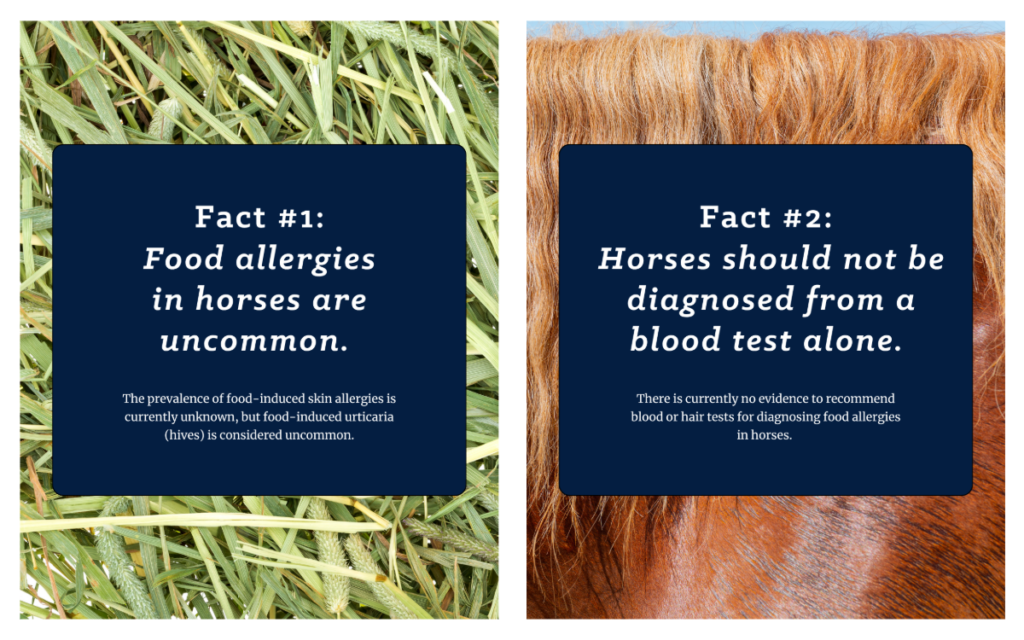
One of the key takeaways from this session was that food allergies in horses are uncommon. Whilst itchy skin and irritations may be common in horses, often feed is mistakenly assumed of be the cause. Many horses with itchy skin actually have other allergic conditions, such as insect bite sensitivity, environmental allergies (atopic dermatitis), and mixed hypersensitivities.
Diagnosis, and pin-pointing feed related intolerances can be tricky. Blood allergy tests are not reliable for diagnosing food allergies. Dr Marsella explained that a positive blood test does not necessarily mean that a horse is clinically allergic to that feed ingredient. Horses can test positive to feeds that they tolerate perfectly well. Therefore, it is important that the laboratory result is matched to what is actually happening or presenting in the horse. The gold standard for diagnosis of a feed allergy is an elimination diet, followed by a challenge. This means simplifying the horse’s diet, back to a basic roughage-only diet, preferably with a roughage source that’s new to the horse, and then monitoring for improvement. Any suspect feedstuffs can then be reintroduced one at a time whilst the horse is monitored for recurrence of clinical allergy signs. Achieving improvement in elimination and relapse after reintroduction, is the clearest way to diagnose a food allergy.
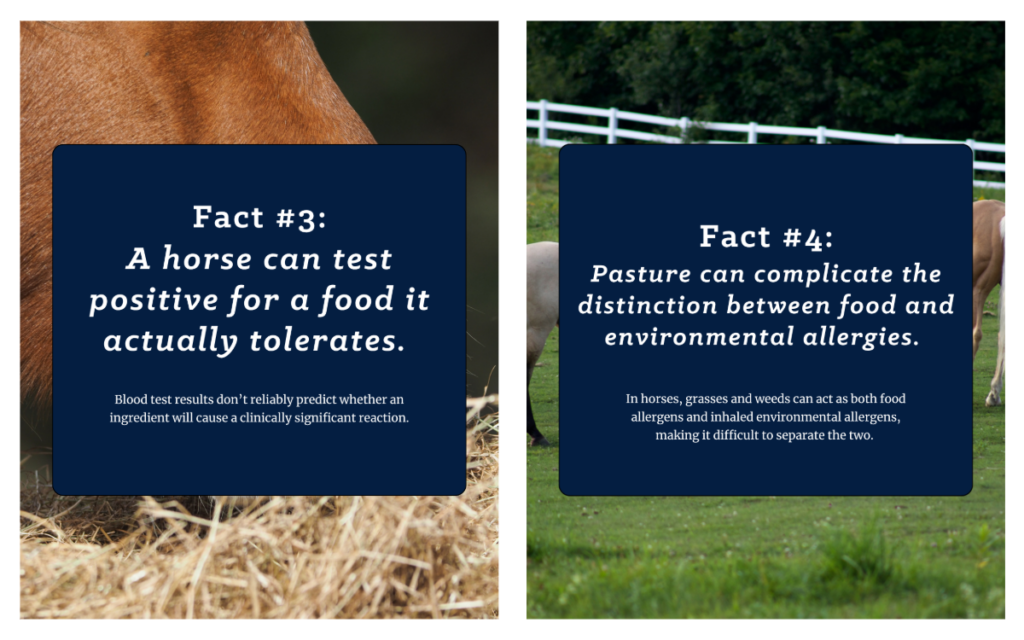
However, definitively diagnosing food allergies for horses can be tricky. This is because many feedstuffs are also environmental allergens. Due to the way horses eat, and their large nostrils in close proximity to the mouth, they may inhale allergens and also ingest them. Often, it can be allergens around the feed room and stables that are the cause, rather than the feed itself. Another consideration is that horses eat different ingredients simultaneous in varying environments. For example, pasture grasses are considered to be both environmental allergens and feed ingredients, and horses may have more than one allergy at a time, making it difficult pin-point.
Navigating this area is best done in consultation with your veterinarian and equine nutritionist. Our equine nutritionist can assist with dietary analysis, advice and education regarding feedstuffs, and were needed, formulate a feed plan for horses that require specialised feeding protocols.
Source: https://ker.com/library/kentucky-equine-research-conference-2026-proceedings/