


Return to Work Feeding Plans
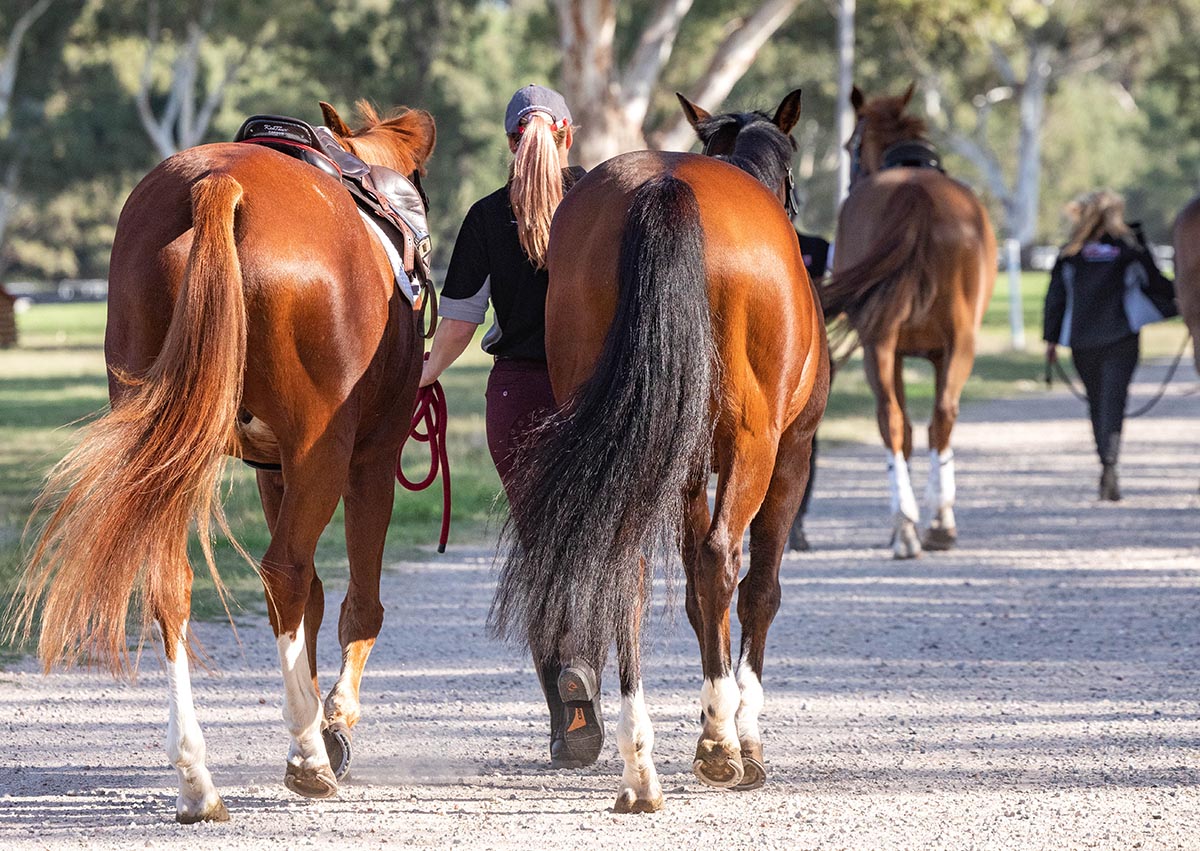
The end of the year brings with it an opportune time to give equestrian horses (and their riders!) a well-earned rest. Likewise, racehorses are routinely sent for spelling after their racing campaigns are complete. Regardless of the time or year, when it comes time to bring them back into work, it’s important to give consideration to your preparation training for horses that have been on a break.
Physiological and physical adaptions occur in horses in response to exercise and training – so there’s a need to define what is exercise and what is training in your program. Exercise is more general physical activity, whilst training is planned activity that increases in duration, difficulty or intensity, with the aim of improving the horse’s fitness and athletic ability. Putting a plan in place is critical for achieving the fitness required and for reducing the risk of injury.
There are several adaptations that occur in horses when beginning training. Muscle develops and changes, cardiovascular output increases, and capillarisation increases to allow for greater oxygen delivery and nutrient circulation/uptake. On a more complex level, a change in muscle fibre type occurs depending on the intensity and duration of the work. Horses in long, slow work will rely mainly on slow-twitch type 1 and 11A muscle fibres, whilst horses in higher intensity work will develop an increased component of type 11A and 11X fibres. Another consideration, particularly in young horses, is bone response to training and increased loading. Bone density and mineral content reduces during periods of rest. In response to training, bone adapts by increasing in density. However, as with all these adaptatations, it takes time, hence the need for an incremental training approach.
Naturally, changes in muscle and bone, along with increased demands on energy, mean that the dietary plan should be adjusted to match the training regime. Typically, horses on spell are fed a lower calorie, predominantly fibre diet. In these cases, care should be taken when re-introducing concentrate feeds. Changes should be made gradually over 14 days and the amount of concentrate should be increased in a similar way to the increments of increase in the training program. It is important to consider the training goals and intensity and choose a feed type that suits. Horses doing long, slow work will benefit from a diet based on fat and fibre, whilst those in more intense training will benefit from some additional non-structural carbohydrates in the diet to fuel muscle contraction.
For horses that have lost muscle tone, feeds such as Pegasus Coolmax and Pegasus Equibalance are ideal. They provide a blend of protein, fat, fibre and moderate NSC to support muscle development without heating up temperaments. Both feeds contain a full vitamin and mineral premix including essential anti-oxidants to assist with muscle repair and recovery during early training. They also contain KER BMC, research proven to assist with bone mineralisation, whilst offering gastrointestinal buffering to assist during dietary adjustments and ‘back to work’ anxiety. Coolmax should ideally be fed at 2-5kg per day. For those horses that are ‘good-doers’ and don’t require that level of feed intake, Equibalance is a great alternative, with a more concentrated feeding rate of 1-2kg per day. For those that require a little extra energy, Pegasus Sweetmax is ideal. It offers a unique multiple energy source approach, providing calories from both fats and carbohydrate grain sources to fuel performance horses without contributing excessive levels of starch. Horses that need a little extra help gaining condition will benefit from the addition of EquiJewel at around 500g per day. EquiJewel works perfectly in conjunction with Pegasus feeds as an extra fat supplement.
Pegasus Lite is well suited to those horses that have done a little too well during a break, and maintain good condition easily. It contains essential proteins, branched-chain amino acids, vitamins and minerals, antioxidants, KER BMC, and KER BioBloom. Its concentrated form allows for a feeding rate of around 400g-1kg per day, making it an ideal feed for horses that require a calorie-controlled diet.
For assistance in formulating your pre-training feeding plan, contact our Equine Nutrition Advisor, Michelle Meylan.